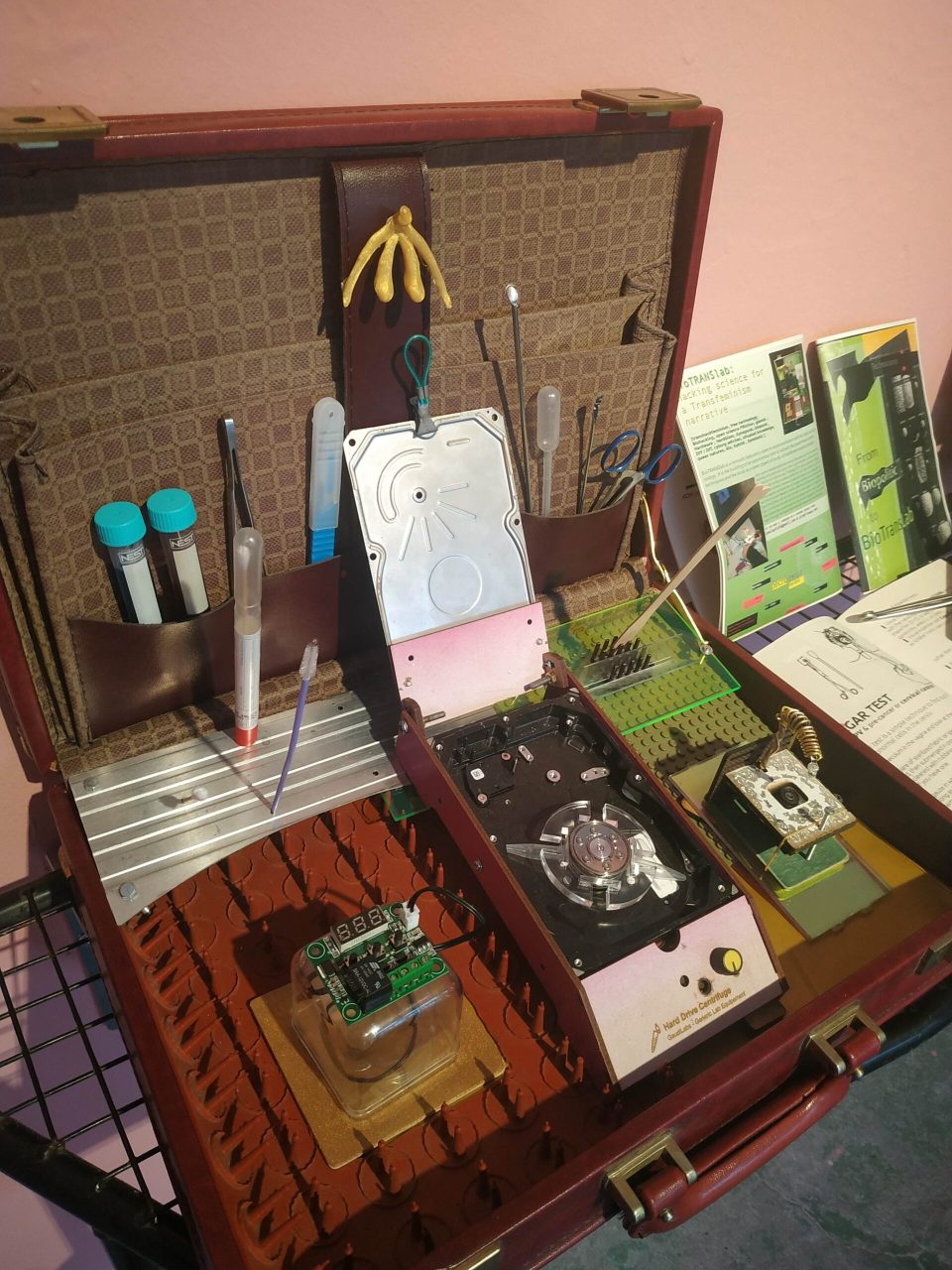
Bio.electro.chemistry and their intra active entanglements. Bio-trans-lab, conceived and coordinated by Pin from Pechblendalab, is one of the multiple disruptive nodes of Hackteria, is a nomadic laboratory open to experimentation with the body and technology, based on the proposal to learn by doing. As a queer transhackfeminist science laboratory (s), this lab seeks the opening of a particular space-time, a place for the confluence of cyber- cyborgs, cyberwitches and alchemists. An invitation to experiment and be traversed by the practical experience of noiSEX disturbance, DIWO or DIT tools, fluids and non-static bodies. It is precisely this extended and non-static body, the tentacular, becoming the condition of possibility to be crossed by the performativity of matter, moving us beyond mere individuality, performing science through collective doings. Starting from the review of evolutionary biology in the contemporary context, the origin of life is understood here as a turbulence of fluids, a metaphor of the new biosophies of collision, friction and symbiosis of entities. One of the biotranslab proposals is to think of us as a constantly changing subject, multiple existences that are no longer defined and do not focus on the division between object and subject. A configuration of other possible narratives that no longer conform to the binarism inherited from modern Western culture. We flow and become, change and tans-form (c) tion, we are the constant re-articulation of complex entities, of uncertain transits and bio-processes, we are meta- organic entities, degenerate post.formations, we are the negation of the pre- existence through the traces that leave the desire and the affections. Affections that deny the positivism of Comte and that propose an Open Science Friction, a set of noises, a sound disturbance against the systemic reductionism of the science, the collective articulation of a degenerated existence.
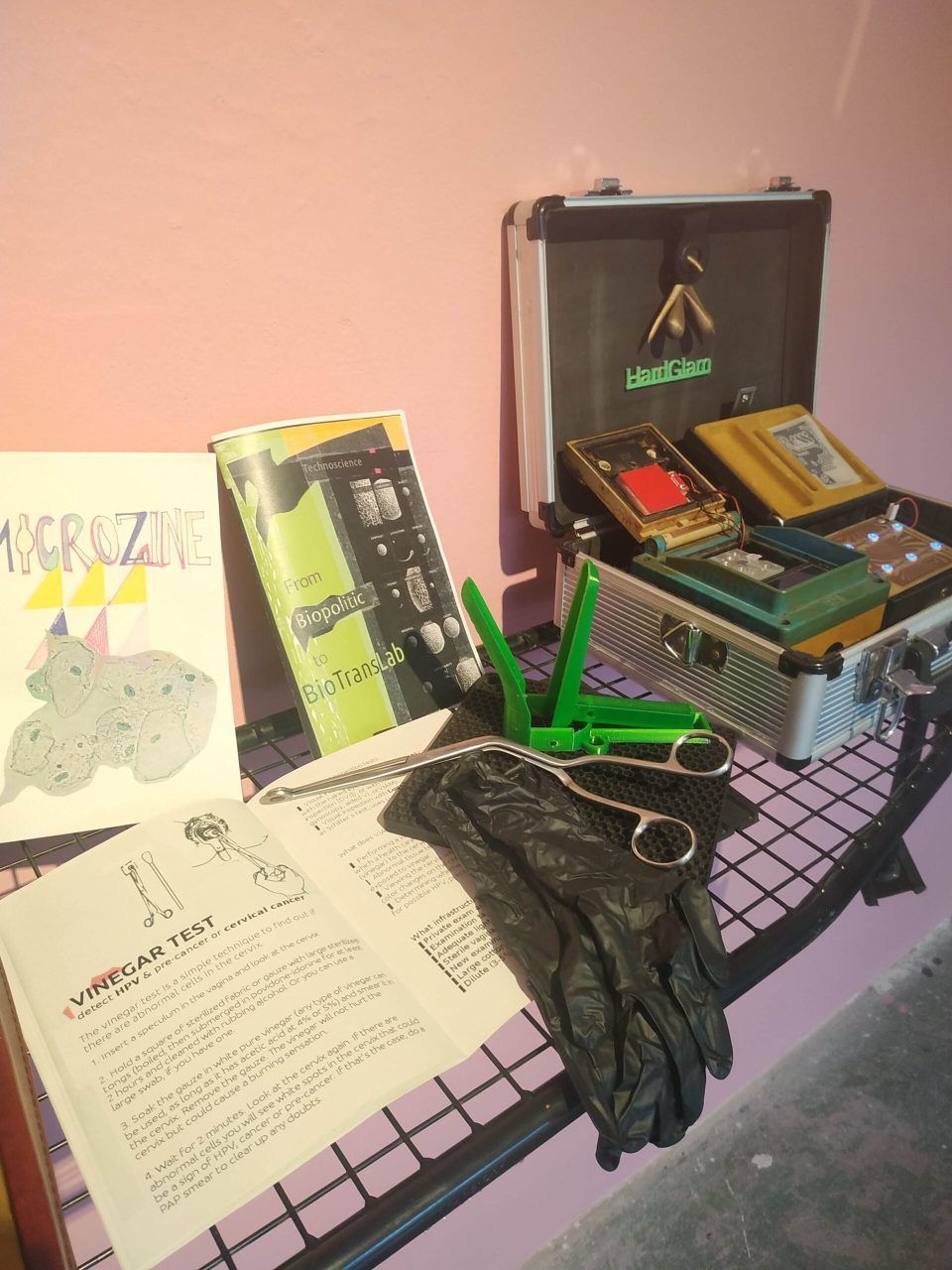
In this context, the lab is understood as a collective ritual of fluids, an entanglement of bodies, devices, codes, frequencies and waves. biotranslab is entangled in Open Science Friction, a biohacker perspective that conceives knowledge from the experience of the body, an expression and transformation of the inherited self, a distancing of individuality through friction and connection. This performance of knowledge (Karen Barad) is essentially the process of learning by doing, the body is rubbing with other agencies and through which are constantly made changes that modify the results, which involves a constant flow through the cracks of spacetime. A fermentation, a movement of transit that moves quickly towards an explosive and expansive movement, towards radical experiments, towards a strong collective confidence. It moves in the attempt to escape from the biopolitical codes that hold our body(s) to relate in a different way, to re-articulate an open ecosystem, beyond the anthropocentric paradigm. A soul-searching of free technologies, situated knowledge, biopunk, cyborg_witches, hardware, software and wetware. HardGlam devices learn from Witchcraft and incorporate the laboratory into magical practice, substituting local technologies for craft tools in simple and complicated ways, and using the Internet for social purposes. These glamorous devices have their own noumenon, acting as a conduit in the use of mechanical objects for communication with queer entities. It is precisely the implication of the expression and transformation of the self through the fluid digital mechanical interaction, which becomes the (re) appearance of the CyborgWitches. The recovery of the knowledge of witches and of these as allegorical and symbolic figures by ecofeminisms, offer us a framework for radical action, borrowing the proposal that only in the extremes we discover. Some Witches have imagined the network as the sublime supercar, and have used the technology of it in experiments to project the self in the liminal space forthe purposes of ecstasy, and to channel, decipher and rewrite this mysterious plane for the development of tactics. disorganization of the imposed paradigms. The figure of the witch in the framework of biohacking practices becomes more acute and enters a transitory state of ecstasy. A use of the ecstasy concept that refers to being outside of it. The individual body is then presented as an interface that can be extended and multiple. The search for a disembodied self that can merge with other entities, assuming an alternative existential condition, degenerated, without binary codes, a non-linear path full of entanglements. The CyborgWitch tactic is an appendix to Witchcraft that seeks charm in a de- naturalized urban context, a context in which we have opposed nature and culture as if at some point they had been separated. CyborgWitch is a dynamic appendix that seeks to break the classic ties that bind us to a traditional link with the organic body, as well as to fight neoliberal discourses and proposals on the improvement of human capabilities through technological implementation. These tactics and collective laboratories are the opposite of some of the transhumanist experiments that take place in the contemporary context, experiments that focus on an exaltation of the technologically overstretched self. A neo-Cartesian conception of cyborg, at the service of a system of productivity and economic returns. The CyborgWitch tactics, on the other hand, conjure the Magic of Chaos from the radical visions of punk. A magical alchemy to heal the imbalances caused by humanism, seeking an emotional balance between nature and technology. A queer nature that is realized through entanglements between non-industrial technology, post- industrial technology and agencies. The aforementioned Magic of Chaos is taken as a borrowed reference to science fiction and quantum physics. It is taken from the search for other possible temporalities. Instead of trying to recover and maintain a tradition that is related to the past, the Magic of Chaos is an approach that allows using any proposal or reference that is considered appropriate as a temporary critical tool, or as a symbolic system that can not be articulated, focusing the importance in what becomes, not in the authenticity of the system, method or methodology used. Therefore, the Magic of Chaos is not a system, but the use and configuration of multiple systems to open other possibilities. The emergence of the HardGlam concept: I love using this definition that Karen Barad contributes next to archive the appearance of the HArdGlam concept after a hands-on experience during device and Hard / wetware networking for my collaboration in 2015 with the Gynepunk process “concepts are never pre-programmed, rather, they are experimental effects of a continuous process that emerges in the making and merges with the manufacture.I like to adopt the term “research-creation” to describe these activities, with the aim of fundamentally rethinking the “theory” and the “practice” of a way that overcomes the too common antagonism between the two.What distinguishes Pechblenda’s laboratory approach from research-creation is its emphasis on philosophy as a creative practice in itself, and his sustained dedication to live experimentation with new forms of transdisciplinary collaboration . Pechblenda’s laboratory projects participate in the thinking process by doing, always with the understanding that concepts are made in and through the event. They practice philosophy as a catalyst for other modes of creative endeavor, never their judge or teacher. Content: Biotranslab : development process carried out by the Pechblendian tentacle Pin and the Hackterian allies. During the process, they implement the idea of a Mobile Laboratory based on Mobile_Labs_Hackathon, _Ljubljana [1] (http://wlu18www30.webland.ch/wiki/Mobile_Labs_Hackathon,_Ljubljan a) and converge with the collaboration they have carried out with GYnepunk during the last three years. 1 Devices and tools of the mobile laboratory. 1.1 – Speculum and the Vinegar test 1.2 – Mary Ward Microscope 1.3 – Incubator 1.4 – Centrifugue 1.5 – PCR Chain reaction of the polymerase NinjaPCR HARDGLAM 1.6 – Camera of Elektropoforesis 1.7 – TRANS.iluminator 1.8 – Autoclave
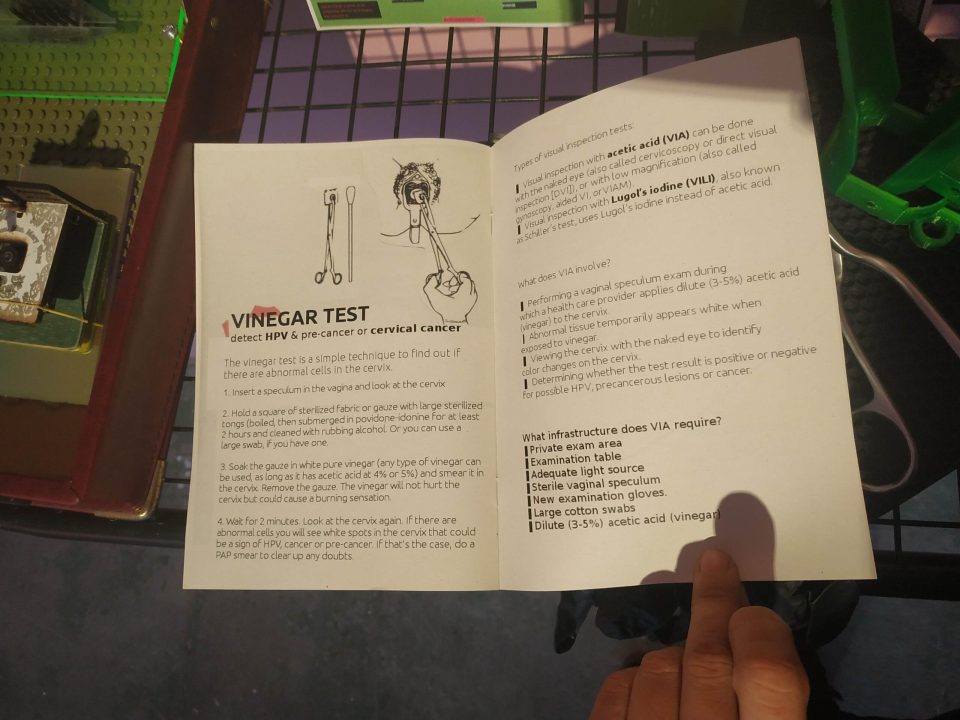
1.1- Speculum and the Vinegar test:
Some images made with spcelums:
https://hackteria.org/wiki/*_Open_speculations
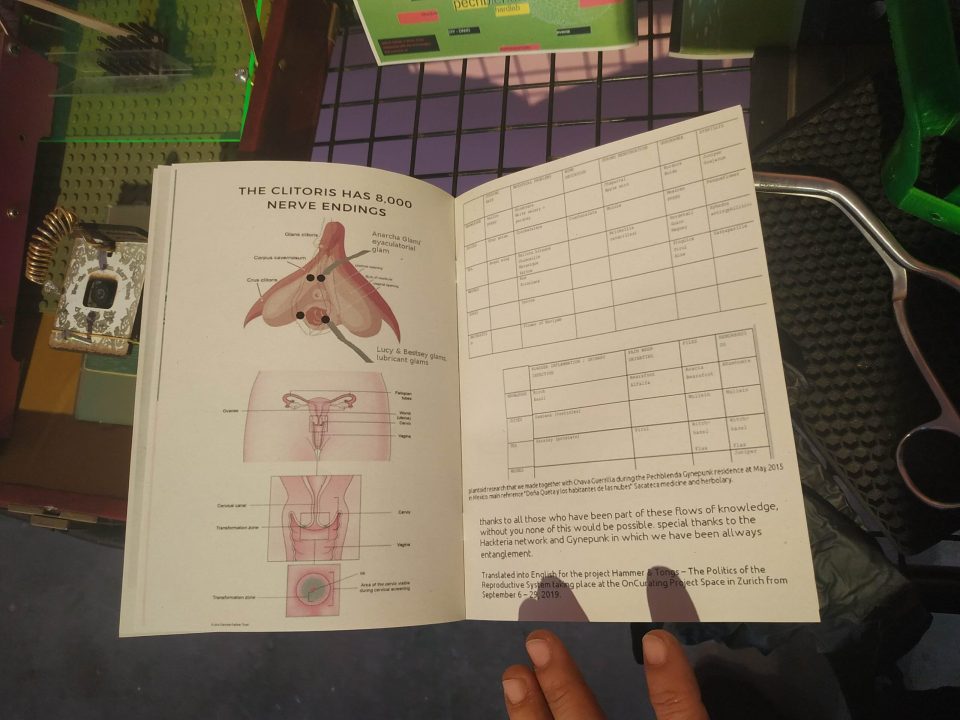
The SPECULUM is a gynecological tool used to access the inside of the vagina
and thus to observe the cervix, it is also used to collect samples flow and
epithelial cells, these epithelial cells are scraped off
carefully on a slide microscopy and the microscope will
allow us to observe the state of the cells depending on
the conformation of their nucleus and cytoplasm.
The 3D speculum that contains the mobile laboratory
arises from the alienation of Urs Gaudenz and Pin in
2017, we have here an evolution of our idea of
fix the camera on the back side to keep the image fixed
and to have a more clear and static view, future
implementations in the field of AI artificial intelligence are
pervista but before we need a Bank of images of Cervises
to continue. in process
1.2- Mary Ward Microscope:
Having a microscope in the clinical laboratory is essential because through it
we can observe minute structures in detail and thereby determine, for
example, the components of a sample, and thereby detect the presence of
microorganisms, viruses, infections, diseases, high levels of glucose,
cholesterol, etc. This instrument is really necessary and with the many current
advances to a large extent benefitted from the realization of more accurate and
precise analyzes, such as the detection of many diseases and the observation
of their structures.
1.2.1- replica of the microscope you can access the Fanzine “from
BioPolitics to BioTransLab” and download it at the following link [3]
(https://archive.org/details/biopoliticsBiotranslabMicrozineHangar )
An introduction to the wonderful world of microscopy, and a delicate guide to
build it your own I leave here some images of the interior
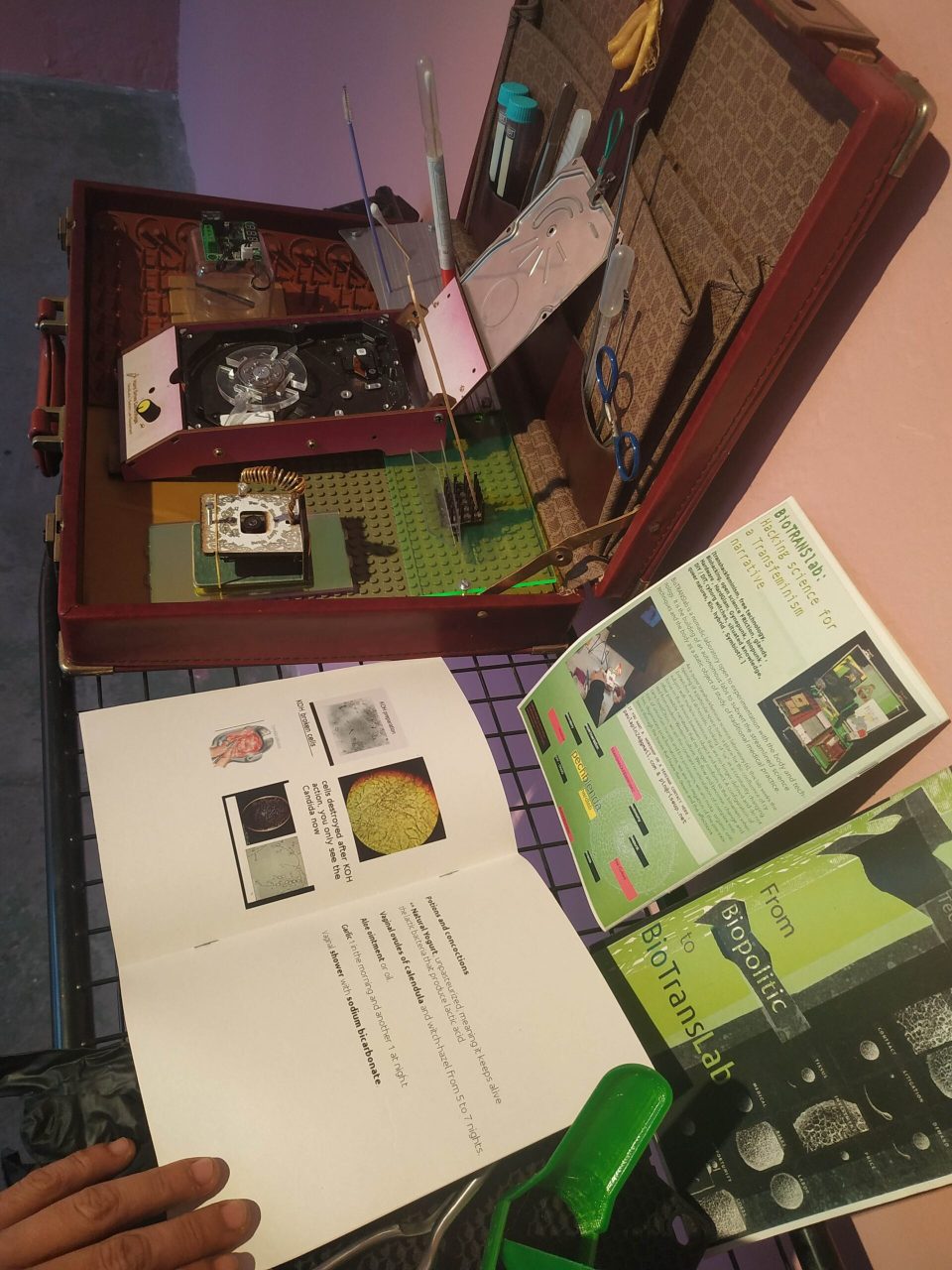
1.2.2- Use your microscope to discover your microflora and beyond There is
a second Fanzine called Microzine that allows you to discover your
vaginal microbiota and make use of low cost techniques to detect
microorganisms sometimes colonizers download it here [4]
(https://archive.org/details/microzine02Hangarnina)
Candida low cost detention technique with an easily accessible chemical KOH
Hydroxide [5] (http://wlu18www30.webland.ch/wiki/KOH/_microscopio)
1.2.3. Use your macrovision:
With this simple technique that consists of depositing a morning slime (spit)
in a glass of water to observe the result, if you see some trickles
descending from the surface to the lower depths you can suspect that you
have Candida